Investment scams are not just poor investments. A poor investment loses money because the business fails, the market moves against the investor, the borrower defaults, or the strategy does not work. A scam loses money because the investment was fake, the seller lied, the platform was controlled by criminals, or the investor’s funds were never used for the stated purpose.
For Muslim investors, that distinction matters, but it is not the only concern. An investment can be real and still fail Sharia standards. An investment can also claim to be halal while being both non compliant and fraudulent. The risk is financial, legal and religious at the same time. That makes the due diligence process more demanding, not less.
Islamic investing is built around principles such as avoiding riba, gharar and maysir, as well as avoiding businesses linked to prohibited activity. A World Bank brief on Islamic finance describes Islamic finance as avoiding riba and gharar, while linking finance more closely to risk sharing and real economic activity. In practical terms, Muslim investors need to ask what is being bought, how profit is generated, who bears risk, and whether the structure is clear.
Scammers know this. They use Islamic words to lower suspicion. A fake investment may be called halal, Sharia compliant, Islamic, sukuk based, asset backed, community verified or scholar approved. Sometimes the words are meaningless. Sometimes the approval is invented. Sometimes the product uses a real Islamic finance term but applies it to a structure that does not match the term. A brochure can say “murabaha” in large letters and still be nonsense underneath.
The first rule is simple. A halal label does not prove a safe investment. It does not prove regulatory approval. It does not prove custody. It does not prove Sharia compliance. It only proves that someone typed the word into the marketing document.
This article is not a fatwa. Product rulings differ by structure, scholar, jurisdiction and contract detail. The aim here is practical: to help traders and investors with basic knowledge spot scam patterns when the pitch is dressed in Islamic language.
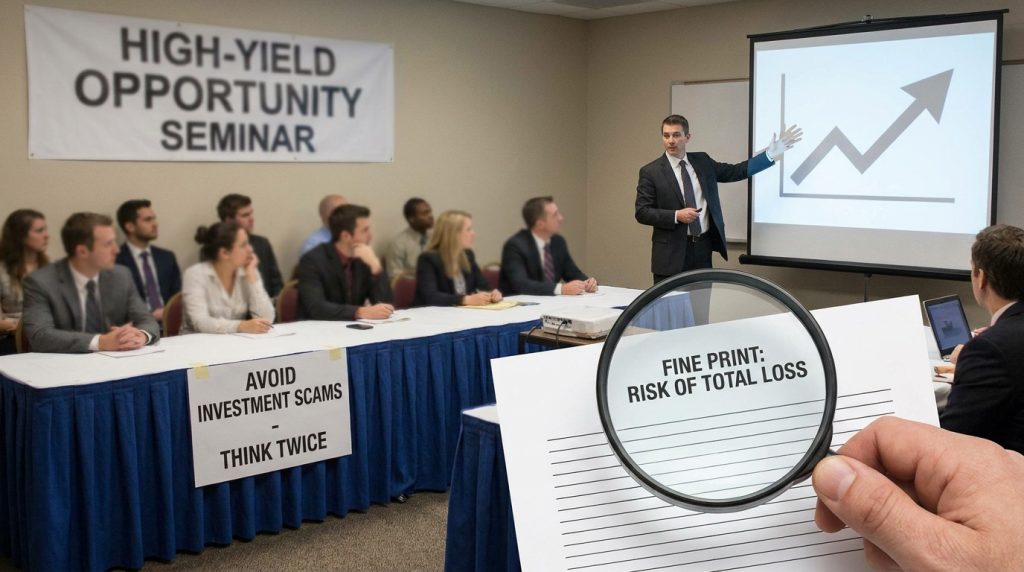
Why Muslim Investors Can Be Targeted
Investment scams often succeed because they use trust. In Muslim communities, that trust may come through family ties, mosque networks, business circles, WhatsApp groups, community leaders, Islamic schools, charity networks or social media pages built around faith content.
That does not mean religious communities are more careless. It means scammers target existing trust channels because those channels lower resistance. If the pitch comes from a stranger on a cold call, the investor may be cautious. If it comes through a cousin, an imam’s acquaintance, a community investor group or a respected local business owner, the investor may ask fewer questions. That is exactly the point.
The SEC’s warning on investment fraud in faith based communities says fraudsters may pretend to share the same beliefs and values, and may even use community leaders to spread an investment without those leaders knowing it is a fraud. Although the SEC alert is written for faith communities in general, the lesson applies directly to Muslim investors. Shared faith can be genuine. It can also be used as a sales tool.
Scam language often changes to fit the audience. In a general retail pitch, the scammer may promise AI trading, private banking access, crypto arbitrage or guaranteed property returns. In an Islamic pitch, the same scam may promise halal passive income, sukuk backed profit, riba free private credit, Sharia screened crypto yield or an “Islamic forex account” managed by experts. The machinery is the same. The packaging has a different colour scheme.
The scale of investment fraud also means this is not a tiny side problem. City of London Police reported that UK victims lost £879.8 million to investment fraud in 2025, with 34,673 people reporting cases and average losses of £25,612. The same report mentioned bogus trading platforms, fake bond schemes, crypto opportunities, social media adverts, cloned branding and AI manipulated material. None of those tactics stops at the mosque door.
A Muslim investor needs two filters. The first asks whether the product is real and fairly sold. The second asks whether it is Sharia compliant. Passing one filter does not mean passing both.
What Makes an Investment Scam Haram as Well as Fraudulent
A fraudulent investment is already a serious ethical breach. It involves deception, theft, breach of trust and often exploitation of vulnerable people. From an Islamic perspective, those issues do not need much decoration. Fraud is not made better because the fraudster adds “insha’Allah” to the closing paragraph.
Still, some scam structures clash with Islamic finance principles in more technical ways too.
The first issue is riba. A scam may offer fixed “halal interest” while trying to avoid the word interest. It may call the payment profit, rent, yield or admin return, even though the structure is simply money lent for a fixed excess return. A genuine Islamic structure needs substance. It should show the asset, trade, lease, partnership or profit sharing arrangement behind the return. If the arrangement is only a loan with a prettier label, the Sharia issue remains.
The second issue is gharar, or excessive uncertainty and ambiguity. Scam investments are often vague by design. The investor may not know who holds the money, what asset is purchased, how title is transferred, how profit is calculated, who bears loss, or what happens if the project fails. Normal commercial risk is allowed in trade. Hidden terms, fake assets and unclear contracts are a different matter.
The third issue is maysir, or gambling like speculation. Some schemes aimed at Muslim traders claim to be halal because there is no overnight interest, but the activity may still resemble betting. Short term binary style products, aggressive crypto prediction games, fake trading dashboards and highly leveraged speculation can all move closer to wagering than investment. Removing swaps does not fix maysir.
The fourth issue is haram business exposure. A fund or trading scheme may claim Sharia compliance but hold conventional bank stocks, gambling companies, alcohol producers, high interest debt instruments or derivatives that do not fit the stated approach. In a real Sharia screened product, the screening method should be disclosed. In a scam, the screening method is usually “trust me, brother”, which is not a methodology.
The fifth issue is amanah, or trust. The person taking money has a duty to handle it honestly. Many Islamic themed scams abuse this directly. They borrow the language of trust, community and brotherhood while hiding the basic facts of custody, fees and loss risk. That is not a small marketing problem. It is the core of the fraud.
Common Investment Scams Aimed at Faith Aware Investors
Fake Halal Funds
A fake halal fund may claim to invest in Sharia screened equities, property, commodities, private trade finance, sukuk or halal businesses. The investor receives a polished PDF, a simple profit projection and sometimes a certificate claiming Sharia approval. The returns are often stable, high and low risk. That combination should always slow the investor down.
A real fund has legal documents, a fund administrator or custodian, audited accounts, clear risk disclosure, manager details, fee schedules and regulatory status where required. A fake fund usually has a website, a brochure and a person who gets annoyed when asked boring questions. Annoyance is not due diligence.
The FCA’s guide to protecting yourself from scams lists common investment scams including cryptoasset scams, forex scams, binary options scams, land banking, boiler rooms, Ponzi schemes and recovery room scams. It also warns that unregulated investments can include products such as gold, fine art, land, whisky, hotels and other asset based offers. That matters because many halal scam pitches use real assets as decoration. Property, gold and trade goods sound tangible. Tangible does not mean real.
A fake halal fund often uses a monthly profit model. The investor may be promised 2%, 3% or 5% per month, paid like clockwork. Real investments do not usually behave like a salary. Equity markets fluctuate. Property projects delay. Trade finance defaults. Commodity prices move. A return stream that looks too smooth may be funded by new investor deposits rather than actual profit.
Fake Sukuk and Islamic Bond Offers
Sukuk are often described as Islamic bonds, though the structure should differ from conventional debt because returns are linked to assets, leases, usufruct or other Sharia compliant arrangements. Genuine sukuk exist and can be issued by governments, banks and companies. Fake sukuk scams use that legitimacy as cover.
The scammer may claim to offer access to a private sukuk issue from a known bank, Gulf based issuer or government linked project. The expected return is framed as safe, asset backed and halal. The investor may be told allocation is limited. The documents may copy the branding of real financial institutions. The payment account may belong to an unrelated company or individual.
This is where brand checks matter. The investor should confirm the issuer, instrument identifier, offering document, regulator filing, payment account and selling firm through independent contact routes. If a real institution is named, contact it through its official website, not the number in the brochure. Clone scams survive because investors check the name but not the contact route.
The FCA Warning List is designed to help users identify firms that may be operating without authorisation, and the FCA notes that almost all UK financial services firms must be authorised or registered. It also warns that dealing with unauthorised firms can remove access to the Financial Ombudsman Service and FSCS protection. A sukuk label does not change that.
Halal Crypto and Token Schemes
Crypto scams aimed at Muslim investors often claim that a token is halal, community owned, backed by gold, linked to zakat, tied to mosque funding, or approved by scholars. Some projects may be genuine attempts to build Sharia conscious digital assets. Many are weak projects. Some are plain theft.
The danger is that crypto combines technical confusion with religious branding. A buyer may not understand tokenomics, smart contracts, liquidity locks, wallet custody, vesting schedules, exchange listings or admin keys. The promoter fills that gap with Islamic language. The investor hears “halal ecosystem” and stops asking who can mint more tokens.
A halal token claim should be checked like any other investment claim. What asset or utility backs the token? Who controls the contract? Is liquidity real? Are founder wallets disclosed? Is there an independent Sharia review? Is that review from a named and qualified party? Does the review cover only the concept, or the actual token, platform and profit model?
Fake crypto yield is even more dangerous. A platform may claim to generate halal returns through arbitrage, staking, trading bots or liquidity pools. The returns may be fixed and high. That is a problem. In Islamic finance and ordinary finance, high fixed returns with unclear risk should make investors twitch.
Forex, CFDs and “Islamic Account” Scams
Many brokers offer swap free accounts for Muslim traders. Some are legitimate. Others use the Islamic account label to pull traders into high risk or fake platforms.
A swap free account may remove overnight interest charges, but it does not automatically make forex or CFD trading halal. There may still be concerns about leverage, synthetic contracts, short selling, ownership, excessive speculation and broker counterparty risk. Scholars differ on some details, but no serious review should stop at the words “no swap.”
Online trading scams also use this label heavily. A fake broker may promise halal forex trading with no riba, guaranteed profits and an expert account manager. The investor deposits funds, sees profits on screen, then cannot withdraw. The issue is not only Sharia compliance. The platform may not be a broker at all.
Investing.co.uk offer a useful retail guide on online trading scam patterns notes that scam victims are often pushed through social media channels, fake investment platforms, broker impersonation and recovery scam follow ups. That is relevant for Muslim investors because the same funnel can be adapted with halal wording, Arabic phrases, community testimonials and religious trust signals.
Property, Land and Development Scams
Property is attractive to Muslim investors because it feels asset backed and easier to understand than derivatives. Scammers know this too. A fake property investment may claim to fund student housing, overseas apartments, hotel rooms, farmland, parking spaces, land development or rental property with fixed halal income.
The asset may exist but be overvalued. It may not exist at all. The seller may not own it. Planning permission may be missing. Rental guarantees may depend on the same company selling the units. Exit routes may be unclear. The investor may be buying an illiquid interest with no real control.
Islamic language can make the pitch stronger. The investor may be told the return is rent, not interest. That could be true in a properly structured lease based arrangement. It could also be a label pasted onto a debt like promise. The contract should show what asset is owned, who holds title, who leases it, who pays expenses, who bears loss, and what happens if rent is not collected.
A real estate investment does not become halal because the building has tenants. It needs clear ownership, lawful activity, fair risk allocation and honest disclosure. It also needs basic commercial sense. If a small developer promises fixed high returns, full capital safety and fast exit, the investor should ask why banks, professional lenders or institutional property funds are not taking the deal first.
Gold, Commodity and Trade Finance Scams
Gold and commodity scams often appeal to faith aware investors because physical assets are easier to connect with trade. The investor may be told funds are used to buy gold, rice, fuel, medical supplies, electronics or other goods for resale. Profit is then shared or paid monthly.
Trade finance can be legitimate. Islamic finance has well known sale and partnership structures linked to real goods. That is why fake trade finance scams are dangerous. They borrow from real concepts.
The investor should verify the goods, purchase contracts, storage, insurance, buyers, profit calculation and auditor. In many scams, none of this is available. The promoter says the trade cycle is confidential or too fast to document. That answer is not good enough. If the investor’s money is needed, the investor’s questions are allowed.
Gold scams add custody risk. Is the gold allocated or pooled? Is there a serial number? Who stores it? Can it be inspected? Is the storage provider independent? Can the investor take delivery? If the answer is “no, but monthly profit is guaranteed,” the investor may not own gold. They may own a PDF about gold.
How to Check a Halal Investment Claim
A proper check starts by separating three questions. Is the investment real? Is the seller authorised? Is the structure Sharia compliant? These questions overlap, but they are not the same.
The first question is about existence. What is the asset, business, strategy or project? Can it be independently verified? Are there filings, accounts, title documents, exchange listings, custodian statements, audited reports or third party confirmations? A screenshot is not verification. A testimonial is not verification. A scholar’s name on a slide is not verification.
The second question is about authorisation. Is the person or firm allowed to offer the product where the investor lives? In the UK, the FCA tells consumers to check whether a firm is authorised and to use official tools such as the FCA Warning List and Firm Checker. If the investment is overseas, the investor should check the relevant local regulator too. A firm can sound global and still be operating from a laptop and a prepaid SIM card.
The third question is about Sharia structure. Who reviewed it? What exactly was reviewed? Was the review done by a named scholar, a recognised Sharia board or a credible Islamic finance adviser? Does the certificate cover the legal documents, or only the broad idea? Is the review current? Does it explain riba, gharar, maysir, ownership, debt levels and prohibited activities?
The fourth question is about return source. A halal return should come from lawful profit, rent, trade, partnership, asset use or risk sharing. It should not come from hidden interest, new investor deposits, gambling like outcomes or fake platform balances. The investor should be able to explain the profit source in ordinary language. If the explanation requires five buzzwords and a miracle, the deal may be too weak.
The fifth question is about loss. Every real investment has a loss path. A business can fail. A tenant can default. A trade shipment can be delayed. A share price can fall. A borrower can miss payments. A product that claims high return and no loss needs evidence, not optimism. Even then, capital protection may introduce its own Sharia questions if it is structured as a guarantee of principal by a manager in a profit sharing contract.
The sixth question is about payment. Money should go to a verified account in the correct legal name, not a personal bank account, crypto wallet or unrelated entity. If the seller asks the investor to mark the payment as family support, consultancy, gift or donation, stop. That is not sophisticated structuring. That is smoke.
The seventh question is about pressure. Legitimate investments may have deadlines, but they do not usually punish investors for taking time to verify basic facts. Report Fraud’s guidance on investment fraud says legitimate organisations will not pressure people to invest on the spot, and recommends seeking independent advice before major financial decisions. That advice is plain, and plain is often what saves money.
Community Trust, Affinity Fraud and Religious Language
Affinity fraud is especially harmful because it turns social trust into a sales channel. In Muslim communities, that can happen through mosque contacts, Islamic study circles, charity networks, business groups, ethnic associations or family referrals.
The promoter may not even be the original criminal. They may be an early investor who received payments and now believes the scheme is real. They may persuade relatives and friends in good faith. This is how many scams spread quietly. Nobody wants to believe a familiar person has brought harm into the community. Sometimes that person is also a victim.
Religious language can make the situation worse. The seller may say the investment helps the ummah, supports halal enterprise, avoids riba, funds Islamic education or gives Muslims access to opportunities usually reserved for institutions. Some projects may genuinely aim to do these things. The claim still needs evidence.
A Muslim investor should not feel guilty for asking questions. Asking for documents is not mistrust. It is responsible stewardship of wealth. If a promoter responds by saying “don’t you trust me?” the investor can answer, calmly, that trust is exactly why clear documents are needed. Good people keep records. Bad people prefer vibes.
Community leaders should be careful too. A casual endorsement can carry weight. Sharing an investment link in a mosque group, WhatsApp circle or community event may expose others to harm. Before promoting any investment, leaders should ask for regulatory status, legal documents, Sharia review, risk disclosure and independent advice. A microphone does not turn a product into a blessing.
What to Do After Sending Money
If money has already been sent to a suspected investment scam, the first step is to stop sending more. Scammers often ask for tax, verification, release fees, compliance payments, wallet unlock charges or recovery deposits. These payments usually do not release funds. They deepen the loss.
The second step is to contact the bank, card provider, payment processor, crypto exchange or wallet provider used to send the funds. Speed matters. Some payments may be frozen or disputed. Crypto transfers are harder to reverse, but records still matter.
The third step is to gather evidence. Save emails, WhatsApp messages, Telegram chats, contracts, PDFs, screenshots, phone numbers, bank details, wallet addresses, website domains, names used by sellers, proof of payment and account statements. Scam websites disappear. Chat accounts get deleted. Evidence should be saved before the story changes.
The fourth step is reporting. In the UK, suspicious financial promotions or firms can be reported to the FCA, while broader fraud can be reported through Report Fraud. In other countries, investors should use the relevant securities regulator, police cybercrime unit or consumer protection authority.
The fifth step is to protect identity. If passports, ID cards, bank statements, selfies or proof of address documents were uploaded, the investor should monitor for identity misuse. Passwords used on the platform should be changed elsewhere, and two factor authentication should be enabled on email, bank and trading accounts.
The sixth step is to avoid recovery scams. The FCA warns that victims may be targeted again by criminals offering to recover money after an upfront payment through so called recovery room scams. These follow up scams are common because victims are tired, embarrassed and desperate for a fix. That emotional state is exactly what the second scammer wants.
Muslim investors may also want to speak to a qualified scholar about any religious concerns after participating in a doubtful product. That should be done calmly. The first priority is stopping further financial loss and preserving evidence. The next priority is understanding what happened and how to avoid repeating it.