Binary options are short term contracts with a fixed yes or no outcome. The trader predicts whether an underlying market will be above or below a certain level at expiry. If the prediction is right, the contract pays a fixed amount. If it is wrong, the trader loses the stake or most of it.
That structure is easy to explain, which is why binary options became popular with retail traders. The trader does not need to understand full option pricing, Greeks, settlement mechanics or complex hedging. The pitch can be boiled down to one sentence: choose direction, choose expiry, get paid if right. This simplicity is also why the product became useful to scammers. It is easier to sell a yes or no bet than a real trading method.
A general market explanation on BinaryOptions.net describes binary options as contracts based on whether a condition is met at expiry across markets such as currencies, indices, commodities and crypto. That description is useful as a product overview, but it should not be confused with a safety endorsement. A product can be simple and still be dangerous. In fact, simple dangerous products are often the easiest ones to sell badly.
The main financial problem is the payoff. If a platform pays 75% or 80% on a winning trade and takes 100% on a losing trade, the trader needs to win well above half the time just to stand still before behavioural mistakes. Many beginners see the fixed payout and think the trade is controlled. The loss is controlled, yes. The probability and edge are not.
Regulators have treated binary options as a major retail harm issue. The UK FCA confirmed a permanent ban on the sale of binary options to retail consumers in 2019 and said firms offering binary options services to UK retail consumers are likely to be scams. The FCA also described binary options as gambling products dressed as financial instruments, which is unusually blunt language for a regulator.
The European Securities and Markets Authority also imposed a prohibition on marketing, distribution or sale of binary options to retail investors in the EU as part of its product intervention work. ESMA’s action was not about one bad broker. It was about the product category causing enough harm in retail distribution to justify intervention.
For Muslim traders, the concern is deeper than retail loss statistics. Binary options also raise serious questions under Islamic finance principles, especially gharar, maysir and the absence of ownership in the underlying asset. That makes the product risky from both a financial and Sharia perspective.
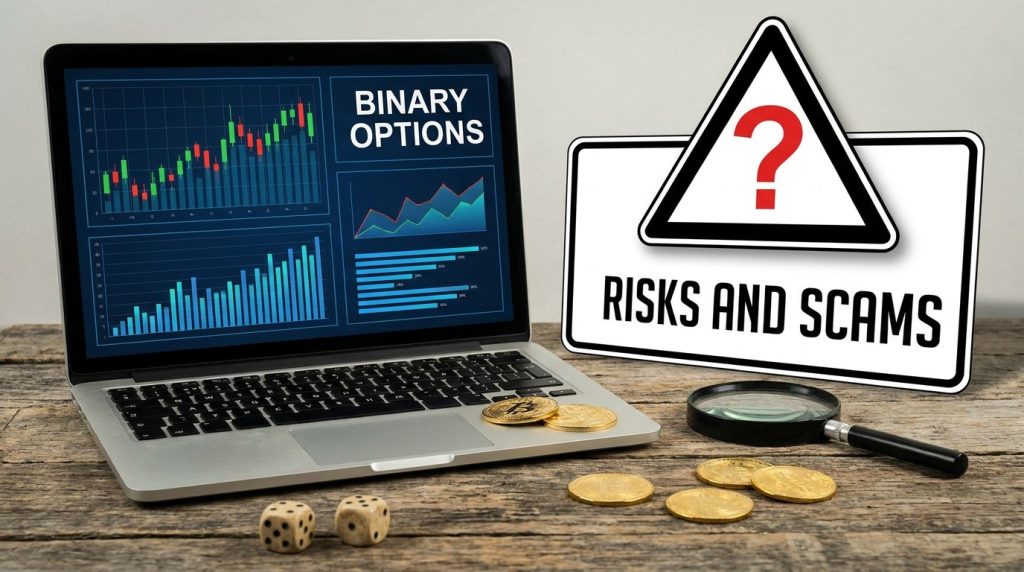
Why Binary Options Raise Islamic Finance Concerns
Islamic finance is not simply conventional finance with interest removed. It also looks at the substance of the contract, the asset being traded, the presence of excessive uncertainty, the possibility of gambling like behaviour, and whether the transaction is linked to real economic activity.
Binary options sit badly with several of these principles.
The first issue is maysir, usually understood as gambling or wagering. A binary option has a fixed all or nothing style payoff. The trader stakes money on whether a market will be above or below a level at a set time. In many retail versions, there is no ownership of the underlying asset, no delivery and no participation in productive activity. The contract is mostly a wager on price direction over a short time window.
That is why many Islamic finance writers treat binary options as haram. A detailed discussion of whether binary options are halal or haram argues that the dominant view among contemporary scholars is that binary options are impermissible because they involve no ownership of an underlying asset, contain high uncertainty and closely resemble maysir. This is not a fringe objection. It goes to the centre of the product design.
The second issue is gharar, or excessive uncertainty. Normal investing contains uncertainty. A business can do well or badly. A share price can rise or fall. A property can rent or remain empty. That kind of risk is part of trade. Gharar becomes more serious when the contract’s value depends on a highly uncertain event with little economic substance beyond the payout itself.
Binary options usually have very short expiries. A trader may be betting on whether EUR/USD closes one pip higher in five minutes, or whether gold is above a line at the end of the hour. The outcome may depend on noise rather than meaningful analysis. There is often no asset transfer and no ownership claim. From an Islamic perspective, that can make the contract look closer to a wager than a commercial exchange.
The third issue is ownership. Islamic commercial law places weight on what is being bought and sold. If a trader buys a Sharia compliant share, there is at least an ownership interest in a business, assuming the company passes relevant screens. In binary options, the trader does not own the currency, commodity, stock or index. The underlying asset is only a reference point for the payout.
This distinction matters. A Muslim investor can take business risk in an asset. That is not the same as paying a stake to receive a fixed amount if a price touches or closes beyond a level. The interface may look like trading, but Islamic analysis looks past the interface.
The fourth issue is riba, though it is not always the main objection in binary options. Many binary trades are too short to involve overnight financing, swaps or margin interest. Some platforms may not charge interest in the usual forex or CFD sense. But removing interest does not make a contract halal if maysir and gharar remain. A casino can refuse to charge interest. That does not change the nature of the game.
This is where marketing can mislead Muslim traders. A platform may say an account is Islamic because it is swap free. That claim does not answer whether the product’s payoff structure is permissible. Swap free is not a magic stamp. It only addresses one possible riba mechanism.
The Difference Between a Risky Product and a Scam
It is worth being precise. Binary options are not always fake in the mechanical sense. A properly structured binary contract can exist. Some traders may use defined outcome contracts to express short term views. The concept of a fixed payout derivative is not impossible to price.
The scam problem sits mainly in retail distribution. Many online binary options platforms have been accused of denying withdrawals, manipulating software, misusing client information and operating without proper registration. The CFTC and SEC’s investor alert on binary options fraud warns about platforms refusing to credit customer accounts, denying reimbursement, committing identity theft and manipulating software to generate losing trades.
That is fraud, not normal trading risk. If the market moves against a trader on a fair platform, the trader loses because the trade was wrong. If the platform changes prices, blocks withdrawals or invents account conditions after the deposit, the trader loses because the game was rigged.
This distinction matters for honesty. A binary option can be high risk without being a scam. A binary options platform can also be a scam even if the concept of binary options is real. Both statements can be true. Traders usually get into trouble when they collapse them into one lazy view.
From an Islamic perspective, the distinction is still useful but less comforting. A product can be genuine and still haram. A platform can be regulated somewhere and still offer a structure that a Muslim trader should avoid. Legal status and Sharia status are not the same test.
For a non Muslim trader, the main question may be whether the price is fair, the broker is regulated and withdrawals work. For a Muslim trader, there is an added question: even if everything is honest, is this contract permissible? With binary options, the answer from many Islamic finance discussions is no, mainly because of maysir and gharar.
That makes binary options unusual. Some financial products are Islamically debated but can be made more acceptable through structure, ownership, delivery or screening. Binary options are harder to rescue because the all or nothing payoff is not a side feature. It is the product.
Common Binary Options Scam Models
Fake Trading Platforms
The most common binary options scam is the fake platform. The website looks like a broker. The dashboard shows trades, balances, price charts and profits. The trader deposits money and starts placing trades. Early results may be positive, either because the scammer allows it or because the screen is simply invented.
The trader may then be contacted by an account manager. The manager says the trader has potential but needs a larger balance to access better payouts, VIP signals or insured trades. This is where the scam moves from small deposit to real damage. The platform is not trying to help the trader improve. It is trying to measure how much can be extracted.
When the trader asks to withdraw, the problems begin. The platform may demand more identity checks, account upgrades, tax payments, verification fees, bonus turnover or withdrawal clearance charges. The trader is told the balance is there but cannot be released until one more step is completed. That step usually involves sending more money.
The CFTC’s separate page on binary options fraud says many online platforms operate in violation of the law and some unregistered platforms have refused account credits, denied fund reimbursement, committed identity theft and manipulated software to create losing trades. That is the core fake platform pattern: deposits are smooth, withdrawals become a maze.
From an Islamic angle, this is fraud on top of an already doubtful product. The trader may start with a contract that resembles maysir, then face deception, false statements and possible theft. There is no clean way to dress that up.
Bonus Traps and Turnover Conditions
Binary options platforms often used deposit bonuses as a control tool. The trader deposits $500 and receives a $500 bonus. It looks like free trading money. It is not free. The bonus may create a turnover requirement that blocks withdrawals until the trader has placed a large volume of trades.
This works because traders focus on account balance instead of contract terms. A platform can show a larger balance while making that balance nearly impossible to withdraw. The trader then trades more, loses more, and may be pressured to deposit again.
A bonus is not automatically fraudulent in every financial product, but in binary options it has often functioned like a leash. It keeps the trader inside the platform long enough for the account to be drained. If a broker offers a bonus that restricts withdrawals, the trader should treat it as a warning rather than a gift.
For Muslim traders, bonus traps add another concern. The trader may be pulled into repeated short term contracts to satisfy a condition created by the platform. That increases speculative behaviour and pushes the activity even closer to gambling mechanics.
Signal Room Scams
Binary options signal rooms promise trade alerts. The seller claims to know when to choose higher or lower, call or put, above or below. The pitch may include screenshots, testimonials, win rates and limited access to VIP groups. Some groups use Telegram, WhatsApp, Discord or private websites.
The problem is that signal performance is easy to fake. Losing trades can be deleted. Screenshots can be edited. A signal provider can send different trades to different groups and then promote the winning side. A public feed can show only selected wins. None of that proves an edge.
Signal rooms are especially risky in binary options because the contract is already short term and fixed outcome. Even a small delay in receiving or entering the signal can change the result. A trade that won for the signal seller may lose for followers entering later at a different price or expiry.
The Islamic concern is also clear. A signal room may turn the trader into a passive participant in repeated wagers. The trader is no longer analysing business value, currency fundamentals or hedging needs. They are waiting for someone to say “up in five minutes.” That is not serious wealth building. It is a queue for a coin toss with branding.
Managed Account Scams
Managed account scams claim that an expert trader will trade binary options for the client. The client deposits funds, gives access, or sends money to a platform controlled by the manager. The account shows profits at first. The manager encourages larger deposits. Then withdrawals fail.
This model works because it removes responsibility from the trader. Instead of learning the product, the client relies on someone who claims skill. The manager may say they have insider access, broker relationships, AI software or institutional signals. The language varies. The aim is the same.
A legitimate investment manager needs authorisation, custody controls, disclosures and verifiable performance. A person on social media with screenshots and a trading name does not become a money manager because the profile picture has a suit in it. The suit may be rented. The losses will not be.
For Muslim investors, managed binary options are even harder to justify. If the underlying activity is impermissible, outsourcing it does not make it permissible. Paying someone else to place doubtful trades is not a workaround. It is just delegation.
Clone Broker and Fake Regulator Scams
Some binary options scammers copy real firms or claim approval from regulators. They may use a similar name, a similar logo, a copied licence number or a fake certificate. The victim searches the firm name and finds something official, then assumes the platform is real.
This is one reason traders should never verify a firm using the contact details supplied by the firm itself. A scammer can provide a phone number that leads back to the scam team. The proper check is to use the regulator’s own register and contact details, then confirm whether the website, legal entity and product match.
The FCA’s statement that retail binary options are banned in the UK is especially relevant here. If a platform claims to lawfully offer binary options to UK retail consumers, that claim itself deserves suspicion. The FCA says any firm offering binary options services to UK retail consumers is likely to be a scam under the post ban framework.
Fake regulator scams also appear after withdrawal problems. The platform may say funds are held by a regulator, tax office or compliance authority. The victim is asked to pay a release fee. Real regulators do not usually ask retail traders to send money to unlock broker balances. That is not regulation. That is theatre with a government font.
Recovery Scams
Recovery scams arrive after the first loss. The victim is contacted by someone claiming to recover binary options losses. They may pose as a lawyer, regulator, law enforcement officer, chargeback specialist or blockchain investigator. They may know the original platform name, deposit amounts and dates. That knowledge feels official, but often means the victim’s details were sold or reused.
The recovery agent asks for an upfront fee. Then another. Then a tax. Then a document fee. The victim is told money is ready to be released but cannot be transferred until a final payment is made. This is the same scam with better manners.
Victims of binary options fraud should be extremely careful with anyone promising guaranteed recovery. Some card payments or bank transfers may be disputed if reported quickly, and some legal recovery work may be genuine, but no honest party can guarantee recovery without reviewing the case and verifying the payment trail.
Halal, Haram and the Problem of Gambling Like Payoffs
Binary options are often marketed as trading, but their payoff structure looks closer to betting than investing. That is the central Islamic issue.
In a normal halal investment, the investor is exposed to profit and loss through ownership, trade or productive activity. A shareholder owns part of a company. A sukuk holder may have rights linked to assets or cash flows, depending on structure. A commodity trader may buy and sell a real commodity under proper conditions. These activities still carry risk, but the risk is tied to something commercially meaningful.
Binary options usually do not work like that. The trader does not acquire the underlying asset. The trader does not contribute capital to a business. The trader does not hold a real economic claim in the index, currency pair or commodity. The trader places money on a stated outcome and receives a fixed payout if that outcome occurs.
That is why the comparison with gambling is hard to avoid. The trader may use charts and news, but the contract’s essence is still a stake on a short term outcome. Research does not automatically change the legal or ethical nature of the payoff. A gambler can study football statistics before placing a bet. The statistics do not turn the bet into trade.
This does not mean all risk is haram. Islamic finance permits commercial risk. Business needs risk. Trade needs uncertainty. A merchant buys goods without knowing the exact resale profit. An investor buys shares without knowing future earnings. The issue is not risk itself. The issue is risk without proper commercial substance, ownership or exchange.
The same distinction helps separate long term investing from speculative screen clicking. A Muslim investor buying a Sharia screened stock is accepting business risk. A trader placing repeated 60 second binary options is taking payoff risk detached from ownership. Calling both “market participation” hides a large difference.
The practical Islamic position is therefore cautious. Binary options should generally be avoided by Muslim traders because the dominant objections are built into the product: maysir, gharar and no ownership. Even if a platform claims to be fair, the Sharia issue remains. Even if a trade wins, the source of the gain is still questionable.
That last sentence matters. A profitable trade is not automatically clean income. Profit only proves that money moved to the trader. It does not prove the contract was permissible.
Broker and Platform Checks Before Trading
For a Muslim trader, the best check may be to avoid binary options entirely. Still, traders researching the product should understand the basic platform checks because the scam risk is high and because similar checks apply across forex, CFDs and crypto.
The first check is legal status. Is the platform authorised in the country where it offers services? Does the regulator’s register show the same legal entity, website and contact details? If the platform claims regulation in a small offshore jurisdiction, what protections actually apply? Regulation is not a profit guarantee, but lack of regulation can leave the trader with no clean complaint path.
The second check is product permission. A broker may be authorised for one service but not another. A firm authorised for general brokerage may not be allowed to offer binary options to retail clients in a restricted jurisdiction. Traders should not assume that a licence number covers every product on the website.
The third check is withdrawal history and terms. Can clients withdraw funds without added payment demands? Are there bonus restrictions? Are there turnover conditions? Are tax or release fees demanded separately? A broker that needs extra deposits before releasing money should be treated with suspicion.
The fourth check is price source. Does the platform explain where its prices come from? Can prices be compared against independent market feeds? Are trades settled according to clear rules? In binary options, small price differences around expiry can decide the entire result. That makes opaque pricing dangerous.
The fifth check is account security. Fake platforms may collect identity documents and payment details for later misuse. A trader who uploads passports, bank statements and selfies to an unknown binary options site may create identity theft risk even before trading losses occur.
The sixth check is Sharia substance. Does the trader own anything? Is there delivery or a real asset claim? Is the payoff more like trade or betting? Is the uncertainty excessive? Does the structure depend on staking money against a short term outcome? With binary options, these questions usually lead to the same answer, and it is not the answer the broker wants printed on the homepage.
What to Do After Losing Money to a Binary Options Scam
If money has already been sent to a suspected binary options scam, the first step is to stop sending more. This sounds obvious, but many victims pay again because the platform says the withdrawal is ready after tax, compliance or release fees. That is often the second stage of the scam.
The second step is to contact the bank, card provider, payment processor or crypto exchange used to fund the account. Speed helps. Some card payments may be disputed. Some bank transfers may be reported through fraud channels. Crypto transfers are harder to reverse, but transaction records should still be saved.
The third step is evidence. Save emails, chat messages, account screenshots, trade history, deposit receipts, wallet addresses, bank details, phone numbers, domains, names used by account managers and copies of documents sent to the platform. Scam sites disappear quickly. Evidence should be collected before the login stops working.
The fourth step is reporting. In the US, binary options fraud can be reported through the CFTC, SEC or FBI Internet Crime Complaint Center depending on the facts. In the UK, suspicious financial services firms can be reported to the FCA, and fraud can be reported through the national fraud reporting route. Local rules differ, so victims should use the proper regulator and law enforcement channel in their country.
The fifth step is to avoid recovery scams. Anyone who guarantees recovery for an upfront fee should be treated as suspicious. Real recovery may be slow, uncertain and document heavy. It will not usually involve sending more crypto to a stranger who claims to be from a regulator.
For Muslim traders, there may also be a personal religious issue after participating in a doubtful or impermissible product. That should be discussed with a qualified scholar or trusted Islamic finance adviser. The financial clean up and the religious clean up are separate tasks, and both deserve calm handling rather than panic.