Forex trading is not automatically a scam. The foreign exchange market is real, large and used by banks, companies, governments, funds and individual traders. Currencies move because of interest rates, inflation, central bank policy, political risk, trade flows and market positioning. A trader can make or lose money from those movements through spot forex, futures, CFDs or other structures, depending on the broker and jurisdiction.
The scam usually sits around the trade rather than inside the idea of currency exchange itself. A trader who loses money because USD/JPY moves against them has taken market risk. A trader who loses money because the platform was fake, the broker was cloned, withdrawals were blocked or the “account manager” invented the profits has been defrauded.
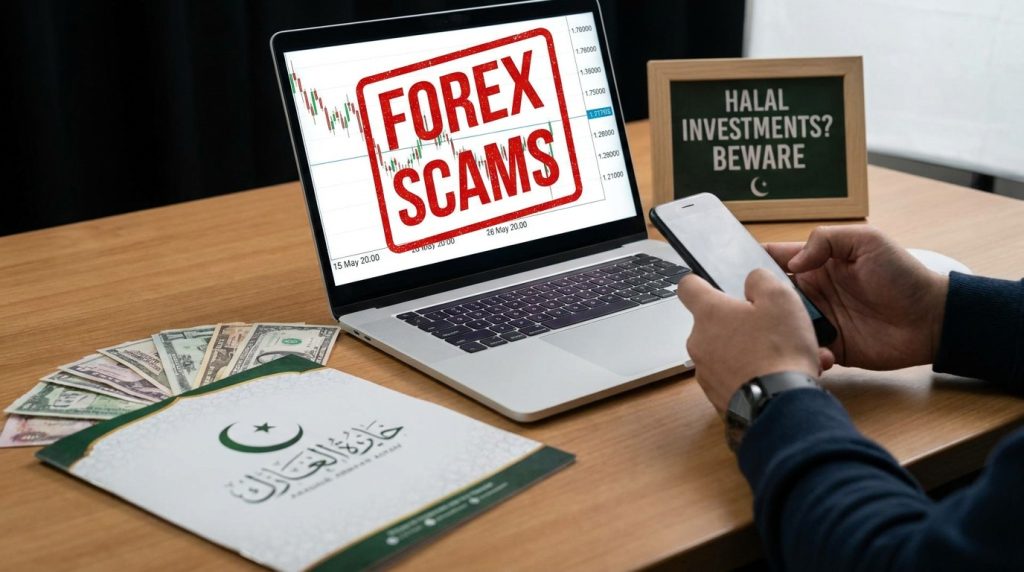
For Muslim traders, the issue has another layer. A forex product can be real and still raise Sharia concerns. It can also be marketed as Islamic while being both religiously questionable and financially fraudulent. That makes forex scam risk more complicated for Muslims than for traders who are only checking regulation and execution.
Islamic finance generally looks at riba, gharar and maysir. Bank Negara Malaysia’s explanation of Islamic banking and takaful describes activities involving interest, gambling and speculative trading as prohibited. In forex, these issues show up through swaps, leverage, contract structure, short term speculation and unclear ownership. A swap free account may remove one obvious interest based charge, but it does not answer every Sharia question.
This article is not a fatwa. Forex rulings differ between scholars because the contract details differ. A spot currency exchange, a leveraged retail forex trade, a CFD on a currency pair and a managed trading scheme are not the same thing. The aim here is more practical: to show how forex scams use Islamic language, how clone brokers steal trust, and how Muslim traders can separate real trading risk from fraud.
The plain truth is that “Islamic account” is not a safety certificate. It is a marketing claim until the broker, contract, fees, custody and Sharia basis are checked.
Why Forex Needs Two Checks: Fraud and Sharia
A Muslim forex trader has to run two separate checks before trading. The first is the ordinary investor protection check. Is the broker real? Is the entity authorised? Are client funds protected? Does the website match the regulator’s register? Can withdrawals be made? Are prices and execution rules clear?
The second is the Sharia check. Does the account involve riba? Does leverage create a loan based problem? Is the contract a real currency exchange or a synthetic bet on price movement? Does the activity resemble trade, hedging or gambling? Are the fees genuine service fees or disguised financing charges?
Both checks matter. Passing one does not mean passing the other. A regulated forex broker may still offer a product that some Muslim scholars would reject. A broker that advertises halal forex may still be unregulated, cloned or fake. A scammer can write “swap free” on a website faster than a trader can read the risk warning.
Regulators have warned for years that retail forex is a high risk area. The CFTC and NASAA state in their foreign currency trading fraud alert that off exchange retail forex is at best extremely risky and, at worst, outright fraud. The FCA’s guide to forex trading scams also warns that unauthorised forex firms may promise high returns, offer managed accounts, clone legitimate firms and make withdrawals difficult.
Those warnings are not saying every forex trade is fake. They are saying the retail sales channel is messy. Forex gives scammers useful cover because the market is real, the language sounds serious and the losses can be blamed on volatility. A fake broker can show a bad trade, a margin call or a news spike and hope the trader accepts the explanation.
Islamic marketing adds another layer of comfort. A Muslim trader may be suspicious of ordinary forex advertising but relax when the page says halal, Sharia friendly, riba free or Islamic. That is exactly where caution should increase. A religious label creates trust, and trust is what scammers need most.
Fake Brokers and Withdrawal Traps
The Fake Broker Model
A fake forex broker looks like a trading firm but does not provide real market access. It may offer MetaTrader style screens, charting tools, account balances, deposit pages and account managers. The trader sees open trades and profit figures. The problem is that the platform may be controlled completely by the scammer.
The first deposit is often small. The trader may send $100, $250 or $500 and see quick gains. The account manager praises the trader’s timing and suggests a larger deposit. The trader is told that more capital will unlock better signals, lower spreads, VIP account status or a safer managed strategy. This is not trading advice. It is deposit grooming.
Withdrawals reveal the truth. The trader asks to withdraw and is told that more documents are needed. Then tax must be paid. Then a bonus must be cleared. Then a compliance fee appears. Then a wallet verification payment is required. Every step creates a fresh reason to send more money before receiving the old money back.
A practical guide on avoiding forex scams describes this pattern as one where false brokers may provide a working looking platform while making withdrawals difficult or impossible through repeated paperwork issues, technical excuses and document demands. That is the point where market risk has ended and fraud risk has taken over.
A real broker may ask for identity checks before a withdrawal. That is normal. A fake broker uses compliance language as a barrier. The difference is whether the request follows stated rules and whether the broker’s legal status can be checked independently. If each withdrawal attempt creates a new payment demand, the trader is no longer dealing with a normal broker process.
The Islamic Angle
Fake brokers often use Islamic account language because it reduces resistance. The trader is told there are no swaps, no riba and no hidden interest. The broker may claim that scholars approved the account, but no named scholar, certificate or contract review is provided. Sometimes the account is not even a real account.
For Muslim traders, this is a double problem. The broker may be fake, and the Sharia claim may be empty. A platform cannot become halal by lying politely. Fraud itself is a breach of basic Islamic commercial ethics, regardless of the product being sold.
The safe approach is to treat any halal claim as something to verify, not something to trust. The trader should ask how the broker removes swaps, what fees replace them, whether the account uses leverage, which legal entity provides the service, and whether the Islamic terms apply to the exact product being traded. If the salesperson answers with pressure instead of documents, that is useful information.
Clone Broker Scams
How Clone Firms Steal Trust
Clone scams are harder to spot than ordinary fake broker scams because the scammer copies a real firm. They may use the name, logo, company number, licence number, office address and risk warnings of a genuine broker. The trader searches the name and finds a regulated firm. That feels reassuring. The issue is that the website, phone number, email address or payment route belongs to the criminal.
The FCA warns that fake trading and brokerage firms may use the name, firm reference number and address of authorised firms, creating what it calls clone firms. Its forex scam guidance also notes that scammers may claim the official register contact details are out of date. That line is important. When a trader notices a mismatch, the scammer already has an excuse ready.
The Forex.ke clone trap guide explains the same method in the Kenyan broker market. It describes how scammers copy a legitimate broker’s branding, website text and registration details, then use similar domains, different payment routes and pressure based promotions to collect deposits and identity documents. The small details matter. A hyphen, a different domain ending or a changed deposit account can be the difference between a real broker and a fake copy.
This is where many traders get caught. They verify the brand name but not the exact domain. They check that the licence exists but not whether the website is the one listed by the regulator. They trust the logo at the top of the page more than the payment account at the bottom. The scammer only needs one of those checks to be skipped.
Domain and Payment Checks
A clone site may use a domain that looks close to the real broker’s domain. It may add a country name, an extra word, a hyphen or a different ending. This is not always proof of fraud because large brokers can operate multiple domains for different regions. Still, the domain should match the regulator’s register or be confirmed through the broker’s official website.
Payment details are often clearer than design. A regulated broker should not need deposits into a personal mobile money number, unrelated company account or crypto wallet controlled by an account manager. The name receiving funds should make sense legally. If the payment route does not match the broker entity, stop.
Kenyan traders have an official route for checking licensed online forex firms. The Capital Markets Authority’s list of non dealing online foreign exchange brokers shows licensed entities and their website details. That exact website check matters because a clone can copy the name but cannot easily make the regulator list its fake domain.
For Muslim traders, clone scams are especially damaging because they can copy both regulatory and Islamic language. A clone may claim to be CMA regulated, Sharia friendly and swap free. None of that means much if the trader is not on the genuine broker site and not funding the genuine legal entity.
Islamic Account Scams and Swap Free Marketing
What Swap Free Means
An Islamic forex account is usually marketed as a swap free account. In conventional margin forex, holding a position overnight may create a swap charge or credit linked to the interest rate difference between the two currencies and the broker’s pricing. Since riba is a central concern in Islamic finance, many Muslim traders look for accounts that remove these overnight interest based payments.
That can be useful, but it is not the whole test. A swap free account may still involve leverage. It may still be a CFD rather than a direct currency exchange. It may still include admin fees, wider spreads or time based charges. Some fees may be legitimate service charges. Others may economically resemble the financing charge they replaced. The label alone does not answer the question.
Islamic finance bodies such as AAOIFI exist to develop Sharia standards for Islamic financial institutions, which is one reason serious Islamic finance products rely on formal review rather than vague marketing claims. Retail forex websites do not always provide that level of detail. Some simply state “Islamic account available” and move on. That is not enough for a trader who cares about compliance.
A Muslim trader should ask what product is being traded. Is it spot forex with actual currency exchange and proper settlement terms? Is it a CFD where the trader only has a contract against the broker? Does the broker provide leverage through a loan? Are positions rolled overnight? Are fees fixed, service based or linked to time and exposure? These questions are not academic. They decide whether the account is only swap free or actually structured in a way the trader is comfortable defending.
When Islamic Labels Become Scam Tools
Scammers use Islamic labels because they work. A trader who would be cautious around a normal offshore broker may relax when the broker says it offers halal trading. The scammer may add Arabic phrases, mosque friendly messaging, community testimonials or screenshots from supposed Muslim clients. None of that proves anything.
An Islamic account scam often combines three promises. The first is no riba. The second is guaranteed profit. The third is expert management. Each one deserves pressure. No riba must be shown through contract terms. Guaranteed profit is usually not credible in forex trading. Expert management requires authorisation, verified performance and proper custody.
A broker promising fixed monthly forex profits through an Islamic managed account is not solving Sharia concerns. It may be creating new ones. Forex trading is volatile. A fixed return with no loss path is suspicious in ordinary finance and questionable in Islamic finance. Risk sharing is not supposed to mean the investor takes the loss while the promoter takes the brochure photo.
Some Islamic account scams also hide behind education. The trader is invited to a halal forex webinar, then moved into a private group. The educator recommends a broker, then an account manager, then a deposit. The trader may not realise that the educator earns from referrals or is part of the same operation. A free lesson can be the front door to an expensive mistake.
Signal Sellers, Robots and Managed Accounts
Signal Sellers
Forex signal sellers provide buy and sell alerts for currency pairs. Some are honest but weak. Some are outright scams. A seller may claim a 90% win rate, guaranteed weekly profit, bank level entries or secret institutional liquidity. The trader pays a subscription or joins a VIP group, often through Telegram, WhatsApp or Discord.
The problem is proof. Screenshots can be edited. Losing trades can be deleted. A seller can post several different calls to different groups and promote only the one that worked. A signal result is also sensitive to entry time, spread and execution. A signal that wins for the sender may lose for the follower entering late.
From an Islamic perspective, signal following can also slip into gambling like behaviour. If the trader blindly opens short term leveraged trades because someone typed “buy now”, the activity may have little connection to trade, analysis or risk sharing. The issue is not only whether the signal is accurate. It is whether the behaviour becomes maysir dressed as market analysis.
Robots and Automated Trading
Forex robots are automated systems that place trades or generate signals. Automated trading is not fraudulent by nature. Professional markets use algorithms every day. The scam version promises hands free income, fixed monthly returns and almost no risk.
The CFTC’s material on forex fraud warns investors to be cautious with forex offers that promise large profits with little risk, especially where sellers use high pressure sales or ask for quick deposits. Robot scams fit that pattern neatly. The trader is sold the fantasy of income without judgement. The robot does the thinking. The trader does the losing.
Muslim traders should also check whether the robot is trading products they consider permissible, whether it uses leverage, whether it holds overnight positions, and whether it trades in a way that resembles repeated wagering. Automation does not change the nature of the underlying trade. A bot can place haram trades faster than a human. Speed is not a Sharia improvement.
Managed Forex Accounts
Managed account scams are common because they target traders who want returns without responsibility. The seller claims to trade on behalf of clients. The account shows growth. The client is asked to add more capital. When withdrawal is requested, fees and conditions appear.
Real managed accounts need proper authorisation, custody arrangements, disclosures and performance records. A person on Instagram or WhatsApp does not become a money manager because they use charts and speak softly. The softer the voice, the sharper the questions should be.
Broker comparison resources can help traders understand account types, regulation and broker features before choosing a provider. For example, ForexBrokersOnline publishes forex broker comparisons and notes that its content is not financial advice, while also disclosing affiliate relationships. That kind of disclosure is worth noticing. It does not remove the need for independent checks, but it is healthier than taking broker recommendations from a stranger who says “brother, trust me” and sends a deposit wallet.
Recovery Scams After a Forex Loss
A recovery scam targets someone who has already lost money. This can happen after a fake broker, clone site, managed account scam or signal room fraud. The victim is contacted by someone claiming to recover the funds. The caller may pose as a regulator, police officer, lawyer, court officer, blockchain investigator or chargeback specialist.
The Forex.ke recovery scams guide describes how recovery scammers may contact victims weeks or months after the first fraud, using details of the original loss to appear credible. They may know the platform name, deposit amount, dates and screenshots. That does not mean they are official. It often means the victim’s data has been reused or sold.
The scammer usually says the money has been traced, frozen or approved for payout. Then comes the fee. It may be called a tax, legal filing fee, blockchain tracing fee, court charge, compliance payment or release fee. Once paid, another fee appears. The recovery process becomes a second scam built on the victim’s hope.
For Muslim victims, recovery scams can use moral language too. The caller may talk about justice, stolen halal income, community protection or punishing criminals. That language can feel comforting after a loss. It should not replace verification.
Real regulators do not usually ask victims to send money to unlock recovered funds. Real police do not need remote access to a wallet or phone. Real lawyers can be checked through official law society or bar records. No one can reverse an ordinary crypto transfer by collecting a “miner priority fee” from the victim. That is not recovery. It is round two.
Safer Broker Checks for Muslim Traders
A safer process starts with the exact legal entity. The trader should know the company name, licence number, regulator, jurisdiction and website. It is not enough to recognise the brand. Large brokers may operate through several entities, each with different protections and products.
The trader should then check the regulator directly. Do not use links sent by the broker or account manager. Use the regulator’s own website. Match the broker name, domain, contact details and permitted activity. In the UK, the FCA’s Warning List and Firm Checker can be used to check firms and possible clones. In Kenya, the CMA licence database should be checked for the exact broker category and website.
Payment route comes next. The account receiving money should belong to the correct legal entity or a recognised payment processor used by that entity. Personal accounts, crypto wallets, mobile money numbers and unrelated businesses are serious warnings. If the broker explains a payment mismatch with a long story, the story is probably doing too much work.
The Islamic account terms should be read before funding. The trader should check how swaps are removed, what fees replace them, whether leverage is used, whether positions can be held overnight, whether the broker can change terms, and whether any Sharia review exists. A named scholar or Sharia board is more useful than a generic halal badge, though even a certificate should be matched to the exact product and current terms.
The trader should also test withdrawal behaviour before increasing size. A small successful withdrawal does not prove long term safety because some scams allow early withdrawals to build trust. Still, withdrawal friction early on is a major warning. If a broker asks for tax, release fees or verification deposits before paying out, the trader should assume risk has shifted sharply.
The final check is behaviour. A trader being rushed is being managed. Pressure, secrecy, guaranteed returns, emotional flattery and religious guilt are not normal broker communication. A serious broker can answer questions without drama. A scammer needs speed because slow traders read documents.